
AMFI-registered Mutual Fund Distributor | ARN-350415
Market Update · Investor Education
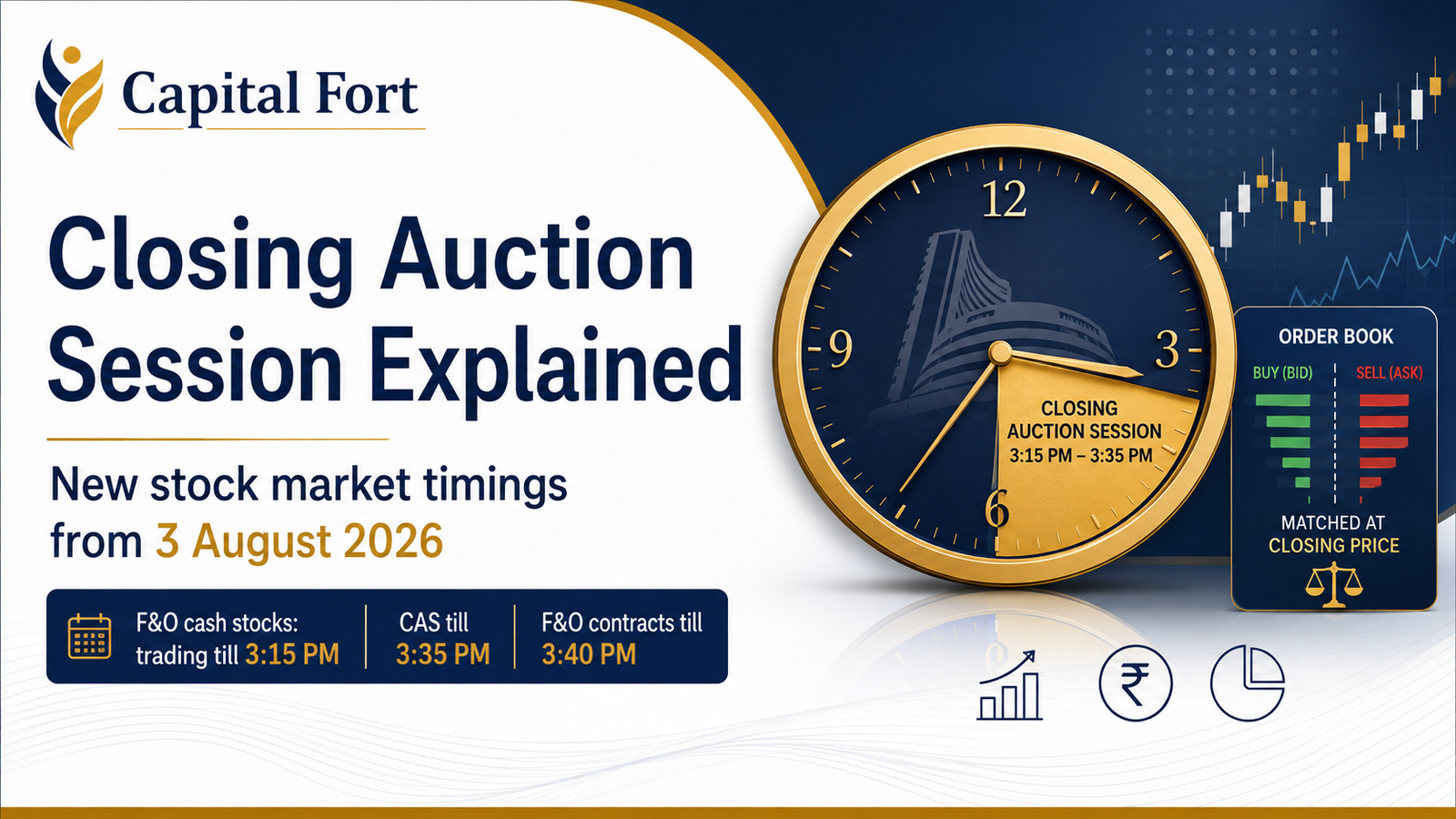
Closing Auction Session Explained: New Stock Market Timings from 3 August 2026
A simple guide to the new end-of-day auction for eligible shares, how the closing price will be discovered and what investors and traders should know.
For years, Indian investors were familiar with regular equity trading continuing until 3:30 PM, followed by the calculation of the day's closing price. From 3 August 2026, that process changes for a selected group of shares.
India’s stock exchanges will introduce a Closing Auction Session, commonly called CAS, for eligible securities in the equity cash segment. In the first phase, it will apply to shares on which derivative contracts are available. The change affects both the final part of the trading day and the way the official closing price of these shares is determined.
Key takeaways
What is a Closing Auction Session?
A Closing Auction Session is a special period near the end of the trading day in which the exchange determines a security’s official closing price through an auction.
During normal continuous trading, compatible buy and sell orders are matched as they become available. CAS works differently. The exchange first collects eligible buy and sell orders and then determines one equilibrium price at which the maximum possible quantity can be traded.
Eligible orders are matched at this single equilibrium price, which becomes the official closing price for that security on the exchange for the day.
Which shares will come under CAS?
CAS will not initially apply to every listed share. In the first phase, it will apply to securities in the equity cash segment on which derivative contracts are available on any recognised exchange.
Securities that are not covered by CAS will continue to trade through the normal continuous session until 3:30 PM, and their closing prices will continue to be calculated under the existing methodology until further guidance is issued.
New stock market timings from 3 August 2026
| Market segment or session | Revised timing or process |
|---|---|
| CAS-eligible shares in the cash market | Continuous trading ends at 3:15 PM |
| Closing Auction Session | 3:15 PM to 3:35 PM |
| Shares not covered by CAS | Continuous trading continues until 3:30 PM |
| Equity derivatives, including index and stock F&O | Trading continues until 3:40 PM |
| Cash-market post-closing session | 3:50 PM to 4:00 PM |
The key distinction is that continuous trading in CAS-eligible cash-market shares ends at 3:15 PM, while the corresponding stock and index derivative contracts can continue trading until 3:40 PM.
How will the 20-minute CAS window work?
Reference-price calculation and transition
Continuous trading ends for CAS-eligible shares. The exchange calculates and disseminates the reference price and transitions the security from the continuous session to CAS. Order entry is not allowed during this period.
Order Entry Period I
Market and limit orders may be entered. Both market and limit orders may be modified or cancelled during this stage.
Order Entry Period II
Only limit orders may be entered, modified or cancelled. Market orders can no longer be modified or cancelled. The order-entry window closes randomly at some point between 3:28 PM and 3:30 PM.
Order matching and confirmation
The exchange determines the equilibrium price, matches eligible orders and communicates trade confirmations. Unexecuted CAS orders are cancelled by the exchange after the matching phase.
*The system-driven random closure takes place during the final two minutes of the second order-entry period.
How is the CAS reference price calculated?
For a CAS-eligible cash-market security, the reference price is based on the volume-weighted average price of trades executed between 3:00 PM and 3:15 PM.
If no trade takes place during that period, the security’s last traded price during the day is used. If the security has not traded during the entire day, the previous trading day’s closing price may be used, with the applicable adjustment for a corporate action.
The reference price is not automatically the final closing price. It is used as a starting reference for the auction, including the applicable CAS price band.
How is the equilibrium price selected?
The exchange first identifies the price at which the maximum quantity of shares can be executed. When more than one price allows the same maximum executable quantity, the exchange considers the price with the lowest unmatched order quantity. If a tie still remains, preference is given to the price closest to the reference price.
A simplified example
| Possible price | Cumulative buy quantity | Cumulative sell quantity | Executable quantity |
|---|---|---|---|
| ₹100 | 1,800 | 1,000 | 1,000 |
| ₹101 | 1,500 | 1,400 | 1,400 |
| ₹102 | 1,100 | 1,700 | 1,100 |
In this illustration, ₹101 allows the highest executable quantity: 1,400 shares. Therefore, ₹101 would be selected as the equilibrium price, subject to the exchange’s full matching rules.
If an equilibrium price is not discovered, the applicable reference price becomes the closing price. If the security has not traded during the day and no equilibrium price is determined, the latest available closing price is considered.
What happens to orders placed before 3:15 PM?
Unexecuted limit orders from the continuous trading session may be carried into CAS when they are within the revised price band. These carried-forward limit orders retain their original timestamp and receive higher time priority than limit orders entered during CAS.
The following orders are not carried into CAS:
- Stop-loss orders
- Iceberg or disclosed-quantity orders
- Orders priced outside the applicable CAS price band
Immediate-or-cancel orders are not permitted during CAS. Market and limit orders are considered for equilibrium-price computation, subject to the rules applicable during each order-entry stage.
What is the CAS price band?
The price band applicable during CAS is set at plus or minus 3% of the security’s reference price. Orders placed outside the applicable range are rejected, and certain outstanding orders outside the revised band are cancelled by the exchange.
Why has CAS been introduced?
A security’s closing price is used across several important market processes, including benchmark-index calculations, portfolio valuation, derivative settlement and the valuation processes used by mutual funds and exchange-traded funds.
By concentrating eligible buy and sell interest into one auction, CAS is intended to support:
- Broader end-of-day price discovery
- A uniform and transparent auction process
- Improved execution opportunities for larger orders
- More efficient closing-price execution for passive investment products
- Closer alignment with closing-auction practices used in several international markets
CAS should not be interpreted as a guarantee of lower volatility, a favourable price or order execution. It changes the method used to discover the official closing price; it does not remove market risk.
How was the closing price calculated earlier?
Under the earlier general methodology, a security’s closing price was usually based on the volume-weighted average price of trades executed during the final 30 minutes of the continuous trading session.
VWAP gives greater weight to trades involving larger quantities. For CAS-eligible securities, the official closing price will instead be determined through the auction’s equilibrium-price mechanism. Securities outside CAS will continue under the existing methodology.
Continuous Trading Session versus Closing Auction Session
| Feature | Continuous Trading Session | Closing Auction Session |
|---|---|---|
| Order execution | Orders are matched continuously when compatible orders are available. | Eligible orders are collected first and then matched through an auction. |
| Price discovery | Prices change continuously during the trading session. | One equilibrium price is selected for the close. |
| Closing-price method | Existing VWAP-based method for securities outside CAS. | Equilibrium price at which the maximum quantity can be matched. |
| Primary purpose | Continuous buying and selling. | Official end-of-day price discovery. |
What does CAS mean for different investors?
Long-term investors
Investors buying shares for long-term goals may not need to change their overall approach. However, anyone placing an order close to market closing should understand that the price displayed at 3:15 PM may not become the final official closing price.
Intraday traders
Continuous trading in CAS-eligible cash-market shares ends at 3:15 PM. Intraday traders should review their broker’s revised square-off and risk-management cut-offs, which can be earlier than exchange timings.
Investors using market orders
A market order entered during the permitted CAS window does not guarantee execution at the last price displayed before 3:15 PM. It may be executed at the equilibrium price discovered after eligible demand and supply are considered.
F&O traders
Equity derivatives trading will continue until 3:40 PM. CAS itself applies to the equity cash segment, but stock-futures price bands are recalibrated for the final part of the derivatives session. The closing price for equity derivatives continues under the applicable VWAP-based framework for the final half-hour, from 3:10 PM to 3:40 PM.
Mutual funds and passive investment products
A concentrated closing auction can provide a common pool of end-of-day liquidity for market participants seeking execution near benchmark closing prices. This may support more efficient implementation by index-tracking products, although actual outcomes depend on liquidity and market conditions.
Is CAS the same as the post-closing session?
No. CAS is a price-discovery session in which eligible orders are collected and matched to determine the official closing price.
The post-closing session takes place later, from 3:50 PM to 4:00 PM. During that session, eligible trades take place at the closing price that has already been determined.
Frequently asked questions
Does CAS apply to every stock?
No. It will initially apply to cash-market securities on which derivative contracts are available. Other securities will continue under the existing framework until further exchange or regulatory guidance.
Can investors trade an eligible cash-market share after 3:15 PM?
Investors may participate through the CAS order-entry process, subject to the permitted order types and applicable timings. Continuous trading in CAS-eligible shares ends at 3:15 PM.
Can a CAS market order be cancelled?
Market orders may be modified or cancelled during the first order-entry period from 3:20 PM to 3:25 PM. They cannot be modified or cancelled during the second order-entry period.
Will all CAS orders be executed?
No. Execution depends on matching demand and supply at the equilibrium price. Unexecuted orders are cancelled by the exchange after the matching phase.
Can the closing price differ from the price shown at 3:15 PM?
Yes. The price displayed at 3:15 PM or the calculated reference price does not necessarily become the final closing price. The final price is generally the equilibrium price discovered during CAS.
Will equity F&O trading still close at 3:30 PM?
No. From 3 August 2026, equity derivatives trading is scheduled to continue until 3:40 PM for both index and stock derivative contracts.
Conclusion
The Closing Auction Session is a major change to the final minutes of India’s trading day. For eligible cash-market shares, continuous trading will end at 3:15 PM, after which an auction will determine the official closing price. Non-CAS shares will continue to trade until 3:30 PM, while equity derivatives will remain open until 3:40 PM.
Investors do not need to become market-structure experts, but they should understand the revised timings, the difference between continuous and auction trading, and the behaviour of market and limit orders during CAS.
Anyone who regularly trades near market close should also review their broker’s operational cut-offs before the framework takes effect.
Stay informed before placing end-of-day orders
Market-rule changes can affect how an order is processed even when your long-term financial goal remains unchanged. Understand the process, review your broker’s timings and make decisions based on your goals and risk profile.
Contact Capital FortSources and editorial references
- Securities and Exchange Board of India, “Introduction of Closing Auction Session (CAS) in the Equity Cash Segment and certain modifications in the Pre-Open Auction Session”, 16 January 2026: SEBI circular.
- National Stock Exchange of India, Circular NSE/CMTR/73362, “Operational guidelines and Standard Operating Procedure on Introduction of Closing Auction Session”, 18 March 2026: NSE circular.
- National Stock Exchange of India, Circular NSE/CMTR/74466, “Introduction of Closing Auction Session in the Equity Cash segment — Trading Modalities”, 29 May 2026: NSE trading-modalities circular.
- National Stock Exchange of India, “FAQ on Closing Auction Session in the Equity segment and changes in Equity Derivatives Segment”, Version 2.0, July 2026: NSE FAQ.
- Bombay Stock Exchange, Notice No. 20260610-41, operating guidelines for CAS, 10 June 2026: BSE notice.
- Groww, “Closing Auction Session (CAS): Meaning, Timings, Process”, used as the user-requested reference for topic coverage and reader-friendly framing: Groww article.
Editorial note: Exchange and SEBI documents were treated as the primary sources. The article uses the official NSE reference-price period of 3:00 PM to 3:15 PM for CAS-eligible cash-market securities. Broker-specific square-off timings are not presented as exchange-wide timings.